Provided by Prince William County
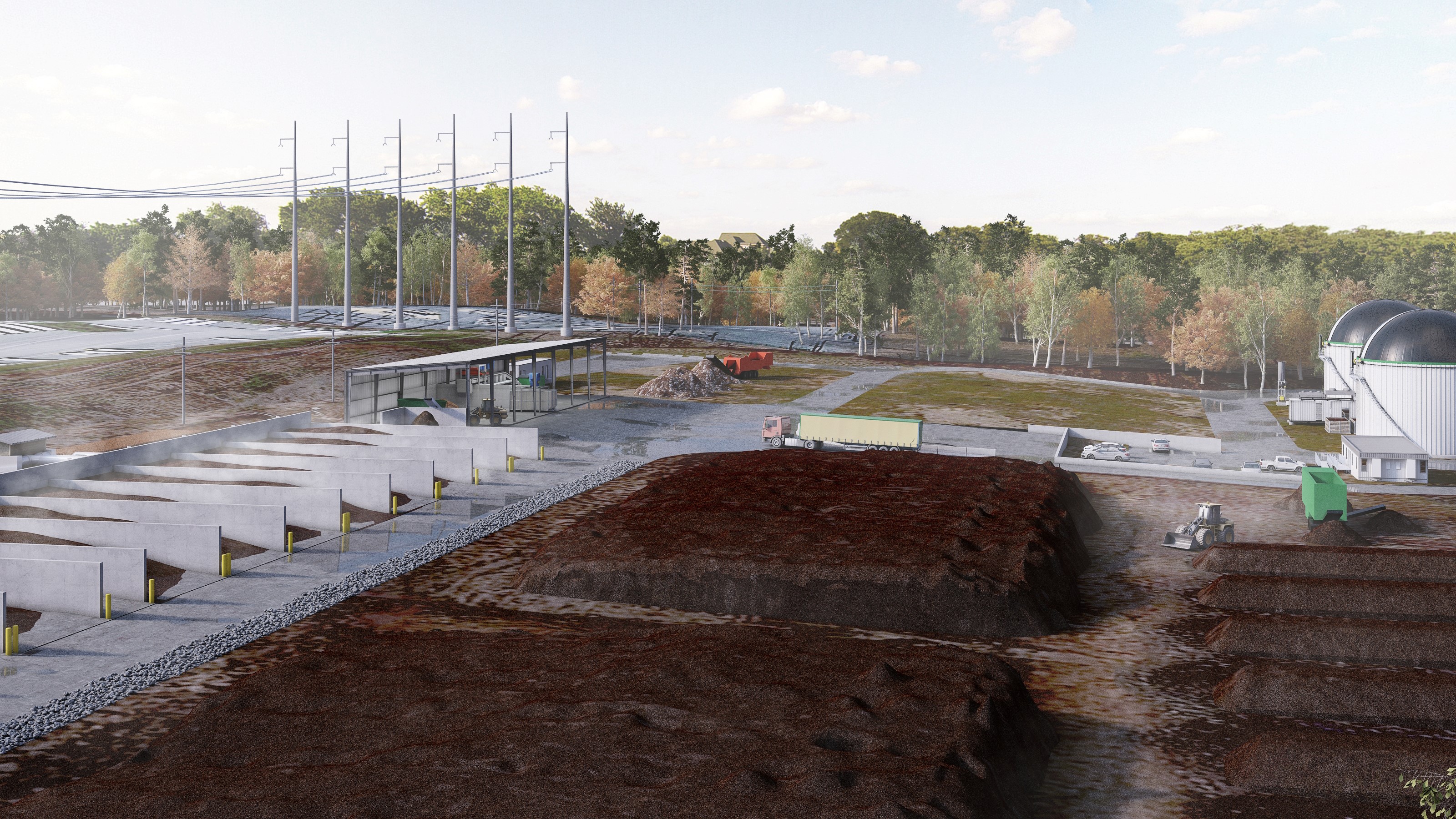
After breaking ground in December, the construction project at the Prince William County composting facility on Balls Ford Road is ramping up with major activity.
The schedule for the project was updated April 1. Those visiting the facility or passing by may soon notice blasting and excavating at the site. Residents are advised to anticipate temporary user changes such as the traffic flow The public’s patience is appreciated as this innovative new facility is brought to life.
The Construction Project
The two-year construction project has two phases. This phased schedule facilitates maintaining all of the services offered at the site. The first phase is creation of the advanced aerobic composting facility, which will process and recycle over 80,000 tons per year of residential and commercial yard waste, institutional and commercial food scraps, and certain types of clean wood waste. The output will be high-value, nutrient-rich soil products, compost, and non-synthetic fertilizers. In addition to the recovery of valuable resources and the environmental benefits of reducing landfilling, this project doubles the throughput capacity of the current Balls Ford Road facility.
The facility is being constructed by Freestate Farms LLC, a local agricultural services and production company, which will also be the operator. Their advanced aerobic composting system will use a reversing aerated static pile composting method, which means that air will be drawn through the piles in both directions (i.e., top to bottom, and bottom to top) in order to ensure an optimal composting environment through the accelerated process. Drawing air down through the piles allows Freestate to capture and scrub and process odors through biofilters before release. The composting system will primarily process leaves and grass, but it is specifically designed and permitted to receive and process all types of food scraps, which may ultimately account for up to 20-25% of total capacity.
Details of the second phase of the project are still being finalized, but they are certain to include an anaerobic digestion and renewable energy system in order to process a greater volume of food scraps and more fully recycle those materials – not only into high quality soil products, but also into clean, local-generated, baseload renewable energy.
The final element of the project will include a commercial-scale controlled environment agriculture system that utilizes the multiple products generated on site to produce fresh, locally-grown, organic fruits and vegetables. This production system will serve as a demonstration model of an integrated and sustainable process, whereby organic soil and fertilizer products along with renewable energy generated on-site are used to grow produce for the local community, with the excess electricity being sold back to the grid. The entire facility will also be a hands-on learning opportunity for both children and adults in the community.
Benefits when Completed
There are several benefits to the County associated with this project. Once completed, the new Balls Ford Road Facility will:
- Increase the organics processing capacity of the Balls Ford Road facility to double that of the present-day;
- Divert waste from the Prince William County Landfill, extending its useful life;
- Establish a foundation for developing a comprehensive County organic waste management program and provide a long-term solution to yard and food waste management;
- Increase the County recycling rate significantly—in the most recent County waste audit, approximately 30% of the waste entering the landfill was organic material that could have been recycled; and,
- Generate private investment in our community and 20-25 new jobs.
The new facility is part of the County’s long-term solid waste management plan, according to Tom Smith, the county’s solid waste division chief. “It’s been in our plan for 10 years to try and divert waste from the landfill—to extend its life,” he said, adding, “and to make products out of what would normally be considered garbage.” The contract with Freestate Farms is a public-private partnership, with Freestate Farms doing the financing, building, and operation of the facility. “It’s all private money involved,” Smith noted, “There’s no County funds.” He added, “We’re able to do this pretty much at the same cost per ton that we’ve been processing yard waste out here for over 20 years.”
Citizen Advisory Group
A Solid Waste Citizen Advisory Group was kept informed and educated throughout the procurement period. Following a full briefing of the proposed agreement prior to going to the Board of County Supervisors, the Group offered its unanimous support for the agreement. The contract was initially awarded in January 2015.
For more information about this project and other Prince William County Solid Waste Division programs and services, visit pwcgov.org/trashandrecycling. For more information on Freestate Farms LLC, visit FreestateFarmsVA.com.