
Earnie Porta
By Carole Keily
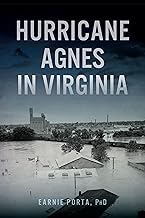
Local historian (and mayor of Occoquan) Dr. Earnie Porta has written “Hurricane Agnes in Virginia,” which describes the impact of the 1972 storm in Virginia. Prince William Living met with Dr. Porta to learn more about the process of writing this book.
Inspiration for Writing a Book on Hurricane Agnes’s Impact on Virginia
“Hurricane Agnes had a major impact on the town of Occoquan and was one of the most important events in the town’s 20th-century history. We held a commemoration ceremony in town for its 50th anniversary, which included the dedication of a sculpture that an artist constructed using metal from the ruins of the old Route 123 bridge that Agnes had wiped out.
“I experienced Agnes myself as a boy in Claymont, Delaware, but to put the storm in context for my remarks at the dedication, I had to do some research. After doing that research I was drawn to the idea of doing a book on the entirety of the storm and approached The History Press with a proposal. Their editorial group responded that a good deal of work had been done on Agnes in Pennsylvania, which was the hardest-hit state, but that Virginia was relatively uncovered. They thus wondered if I would be willing to refocus on Virginia, which of course I was willing to do.”
Research Methods Used
“Information on the science and history of hurricanes came from a number of secondary sources, of which there are many. But the experiences of the various communities in Virginia came from primary source materials that included communications with civil defense headquarters during the storm from local civil defense personnel, first responders, and others; local newspaper accounts; and after-action reports from a variety of state and federal agencies. Some of these required travel, particularly to the Library of Virginia in Richmond, while some of it could be done online using a variety of online databases that are accessible through Prince William Public Libraries.”
How Porta’s Background as Historian and Mayor Informed his Approach
“This subject matter is really outside my academic wheelhouse. Although I write local history, my History PhD focused on North Africa and the Atlantic World in the early modern period, so I find doing local history a different kind of challenge. Two things in particular informed my approach in terms of my personal experiences and my insights as mayor.
“First, although when writing history you almost always want to place your examination within the context of larger issues …, local history really lends itself to and often insists upon incorporating the personal experiences of individuals, which is an added challenge when trying to address larger issues that good history hopes to help educate people about for the future.
“Second, getting personal experiences right is tough, and you inevitably do some injustice. All you can do is … acknowledge to yourself your own potential biases, critically evaluate your source material, and try to figure out what is most likely in context of the historical evidence you have.
“As mayor of Occoquan, I already knew that people’s memories of Agnes were all over the map. Some barely remembered it, others have created whole mythologies around it, and for some it was actually life-changing and even life-threatening.”
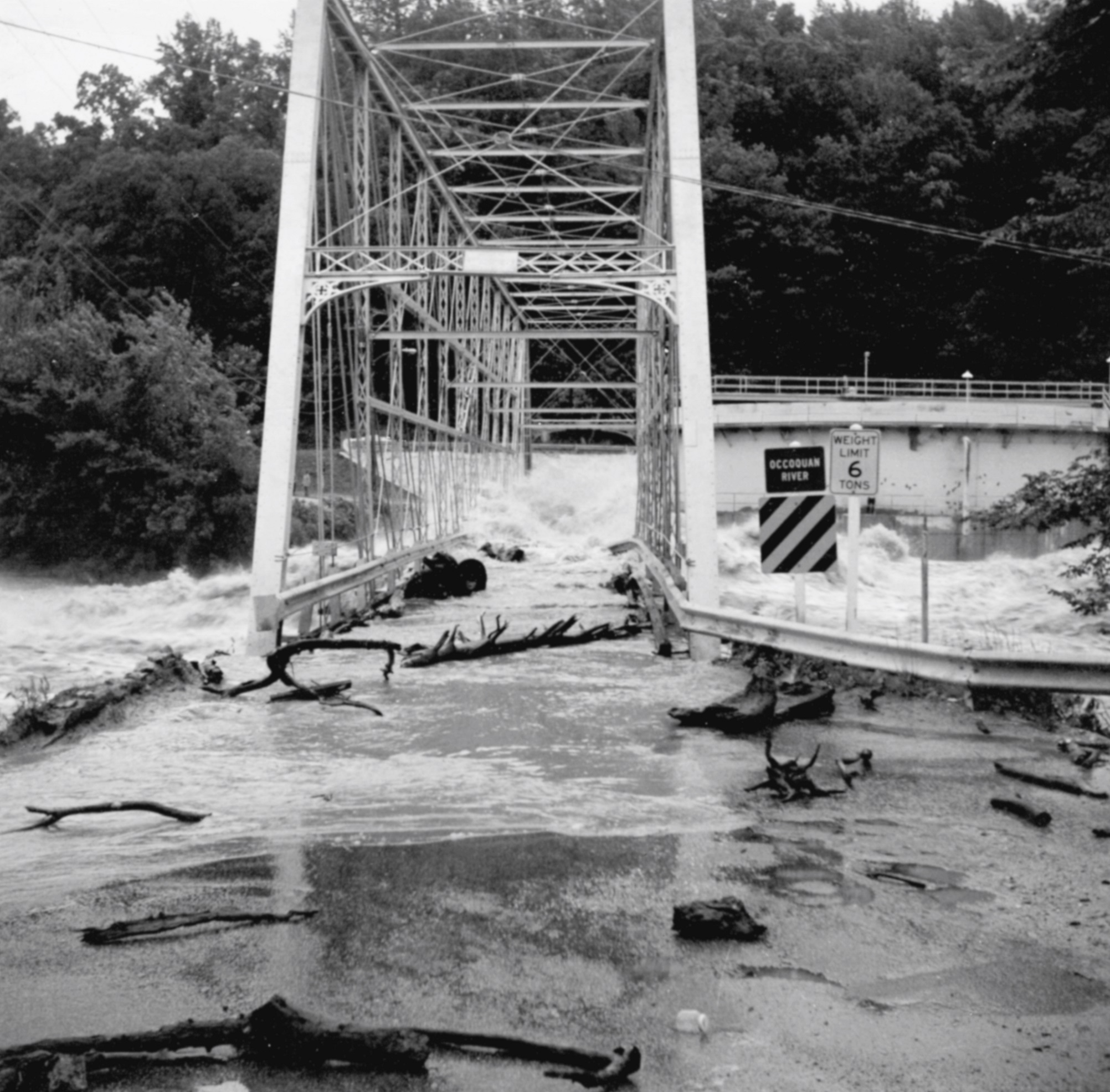
Hurricane Agnes at the Occoquan Old Route 123 Bridge
Surprising Discoveries
“Three things really surprised me. First, is our repeated confidence in our knowledge and abilities only to have nature punish us for our arrogance. One thing I discuss in the book is a National Weather Bureau advertisement from July 1935 that ran in national papers and asserted that thanks to changes at the Weather Bureau we would now be able to “thwart” storms. A little over a month later the Labor Day Hurricane struck the Florida Keys, killing hundreds of World War I veterans who were employed building a road from Miami to Key West.
“Second was just how difficult it was to prepare for a storm like Agnes in 1972. To get accurate river levels to anticipate flooding, for example, typically required a local civil defense volunteer driving or walking to a manual river gauge, reading it, and then getting to a phone to report it. Now imagine trying to do that in the midst of the wind and rain of a major storm. Assuming you could even get to the gauge over washed-out or blocked roads and read it, you then had to find a working telephone when lines were potentially down all over the area.
“There were no cell phones and no internet. In fact, even using satellite images to track storms had just begun. To make matters worse, imagine trying to do this in the dead of night in some rural area.
“That is basically what people had to confront when Hurricane Camille hit Virginia in 1969 killing approximately 120 people of whom more than 30 were never found. It remains the worst storm ever to hit Virginia in terms of lives lost and one of the things that made it so deadly relative to Agnes was that it occurred overnight and there was little way to gather information and warn people because the communication technology we have today simply did not exist. Camille led to a major revision in emergency preparedness in Virginia, which was just really being implemented when Agnes struck in 1972.
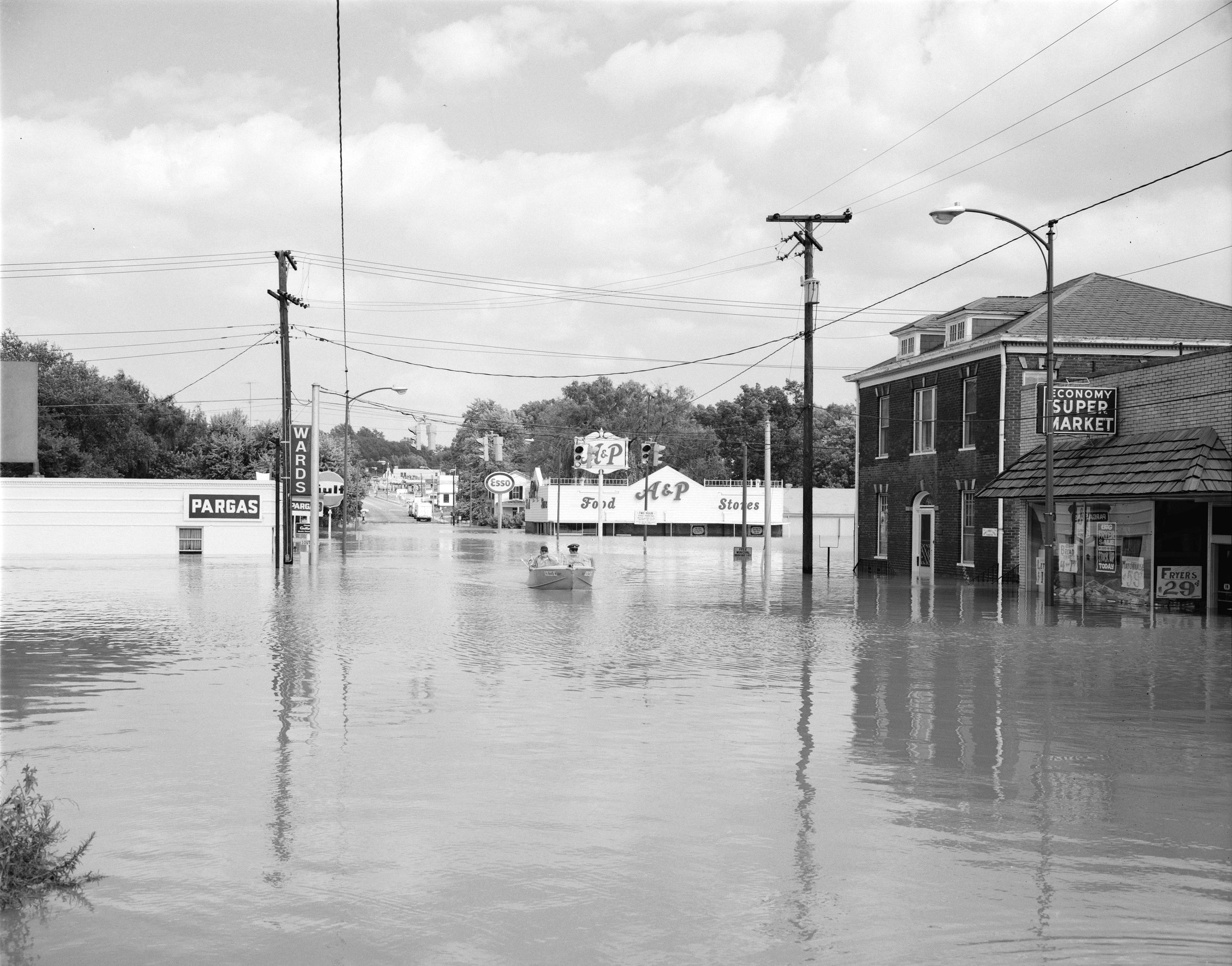
Flood waters in Farmville were high enough to allow boats on Main Street. This view is from the corner of Third Street and Main Street. No. 72-893, Virginia Governor’s Negative Collection, Library of Virginia.
“The third thing that surprised me was the amount of dangerous misinformation that circulates during a natural disaster. I was surprised at the amount of it that had to be navigated by emergency management personnel in real time under pressure. It is easy to consider this no big deal, but the truth is that in an emergency situation proper allocation of emergency response resources is critical and their misallocation can be as deadly as the underlying disaster itself. This holds lessons I think for those who would use or rely upon social media during a disaster.”
The Process of and Challenges in Compiling these Stories
“Most of the stories on individuals affected by Agnes came from local newspaper accounts during and shortly after the storm. Some of the stories about communities as a whole came from official after-action reports. The biggest challenge, understandably, was with the former. Reporters, like everyone at the time, were fighting the elements in real time, trying to make sense of confusing and sometimes inaccurate information, speaking with individuals who were under stress or who had experienced trauma, etc., and as a result, sometimes they or the people they were interviewing got important things wrong.
“This was most easily evident in the death tallies, which as grim and tragic as they are, were also an interesting historical forensics challenge. Newspapers would sometimes misreport, misspell, or combine names in the lists of fatalities, and then other newspapers, government reports, or other sources would pick up those errors and repeat them. One of the parts of the book of which I am most proud is Appendix II, where I discuss this issue and list the individuals who died as a result of the storm, along with some information about each of them. I thought it important that they be remembered and so I spent a lot of time to try to get this right, including tracking down their death certificates.
How Hurricane Agnes Stands Out Among Natural Disasters in Virginia
“For one thing it was the first test of the new emergency response system put in place after Camille came through in 1969. In that respect Agnes represented substantial improvement in the state’s approach to natural disasters.
“Secondly, with Agnes we see some communities respond with significant growth, some survive in a largely static state, and others effectively disappear soon after. For us in Prince William County Agnes stands out in part because along with the city of Richmond, we were one of the hardest hit areas in the state. The effectiveness of our responses varied within the county and ultimately exposed some significant shortcomings that needed correction.”
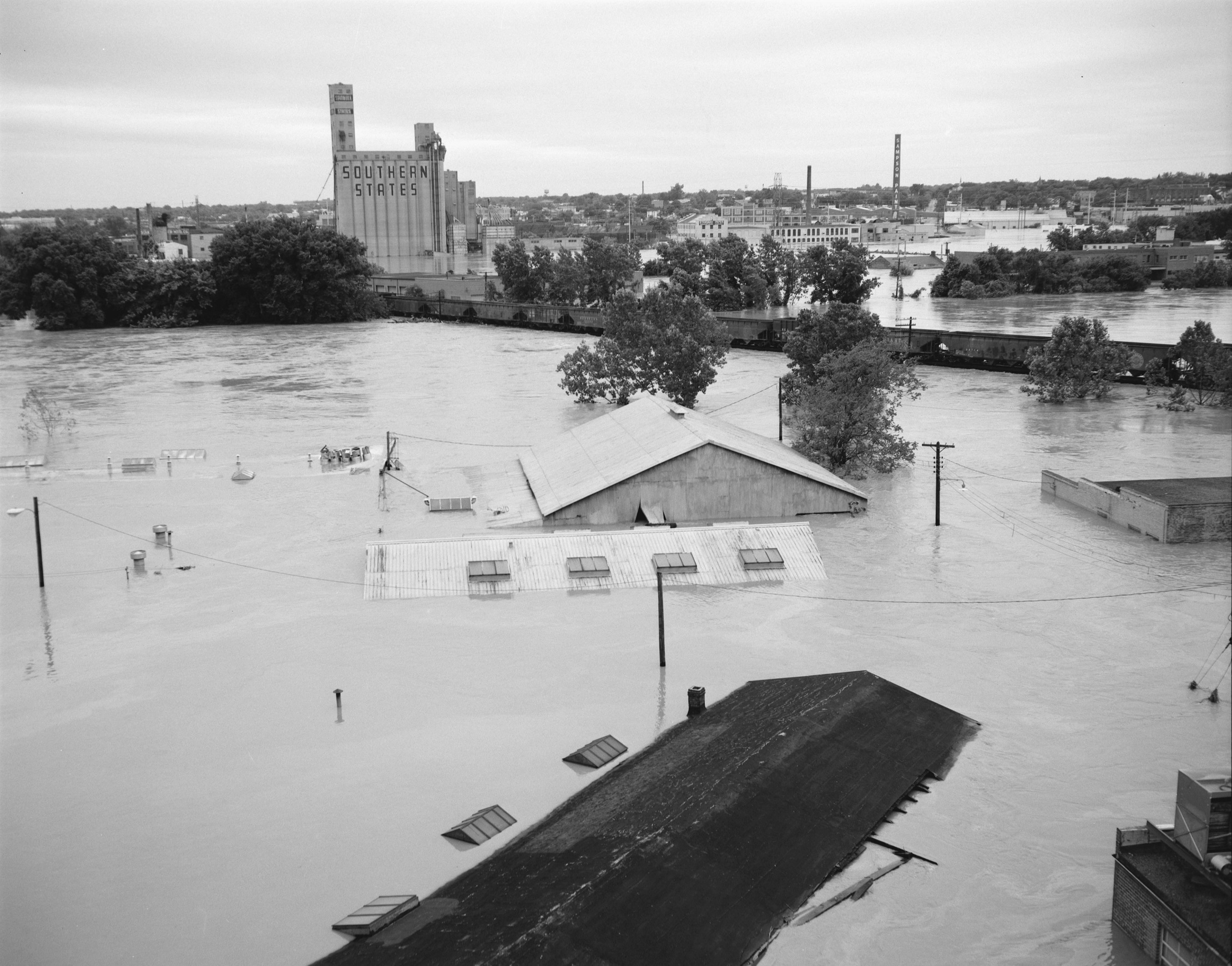
View from I-95 shows several buildings under water in Richmond. No. 72-956, Virginia Governor’s Negative Collection, Library of Virginia.
Providing a Comprehensive Understanding
“I tried to do this by describing the conditions in the various communities before Agnes, then telling what they experienced during the storm, and then discussing the aftermath in those communities – aftermath not only in terms of the immediate cleanup, but how Agnes impacted those communities long-term.
“Overall, I think I was reasonably effective at this, though I confess to being a little disappointed in how Chapter 2, which addressed conditions before Agnes, turned out. I tried to give people a sense of the geography of the state in that chapter and how it affected those communities during the storm, as well as provide some of the history of those communities pre-storm and the state of civil preparedness at the time. In retrospect I think that was probably a little too much to try to cram into that chapter given length constraints, and some of my segues did not quite work out as I had planned.”
How Agnes Shaped the National Conversation about Disaster Preparedness and Response
“In this respect Agnes was very important. Its immediate aftermath played a role in the presidential race of 1972, but longer-term the storm and its aftermath helped spur the professionalization of disaster response expertise (ultimately contributing to the creation of FEMA), and really helped move civil defense activity away from a rather antiquated and sclerotic focus on nuclear war and foreign invasion toward the much more frequent threat of natural disasters.”
Poignant Stories
“A few things remain vivid with me. One, of course, is the idea of firefighters showing up at night and knocking on doors in Occoquan to evacuate the entire town. Another is how in Nelson County, Virginia, where whole communities and generations of families had been wiped out by Camille in 1969, law enforcement arrived to order evacuations as Agnes approached only to find people were evacuating on their own – they remembered Camille.
“The most poignant for me, however, is related to two fatalities and would likely go unnoticed by a reader as the details are addressed in a footnote. An Illinois minister and his wife in their sixties were swept off Route 60 in Rockingham County after allegedly ignoring roadblocks and driving into floodwaters with, according to initial accounts, two children in the vehicle. Subsequent reports never confirm or mention any children, though it is unclear if this is because of a policy not to report the names of minors. Additional research suggests that the couple may have been on the way to the marriage of their daughter in Fort Monroe, Virginia, which appears to have taken place soon thereafter.”
Readers’ Takeaways
“First, I hope it gives [readers]a better sense of how storms like Agnes emerge and the many ways they can cause damage.
“Second, I hope they gain a greater appreciation for the chaotic conditions in which first responders and other emergency personnel have to operate and make decisions in real time during a natural disaster and that this in turn encourages people to act responsibly in such situations to make the jobs of those individuals easier to everyone’s benefit.
“Last, I hope they learn a little bit about other communities in Virginia, what those communities experienced during Agnes, and how the challenges and suffering faced by such disparate communities can point to a common identity amongst us all.”
Carole Keily is Prince William Living‘s Online Editor.