
By Carla Christiano
It started with a challenge from Helen Keller, probably the most famous deaf/blind person in the United States. A popular speaker and advocate for the American Foundation for the Blind, 45-year-old Keller spoke to the 1925 international convention of the Lions Club and asked the question that would change the then eight-year old service club forever: “Will you not constitute yourselves Knights of the Blind in this crusade against darkness?”
Now, Lions Club International is 102 years old and the largest volunteer service organization in the world. It has more than 1.4 million members belonging to 47,000 local Lions Clubs in more than 200 countries. Their global causes are vision, diabetes (which can cause blindness), hunger, environment and childhood cancer. In the Prince William area, an estimated 300 individuals in eleven clubs, including the Linton Hall Leo Club for students in grades 5th through 8th, do much to fulfill the Lions’ mission and meet Keller’s challenge.
Lions Lead the Charge for Vision Screenings and More
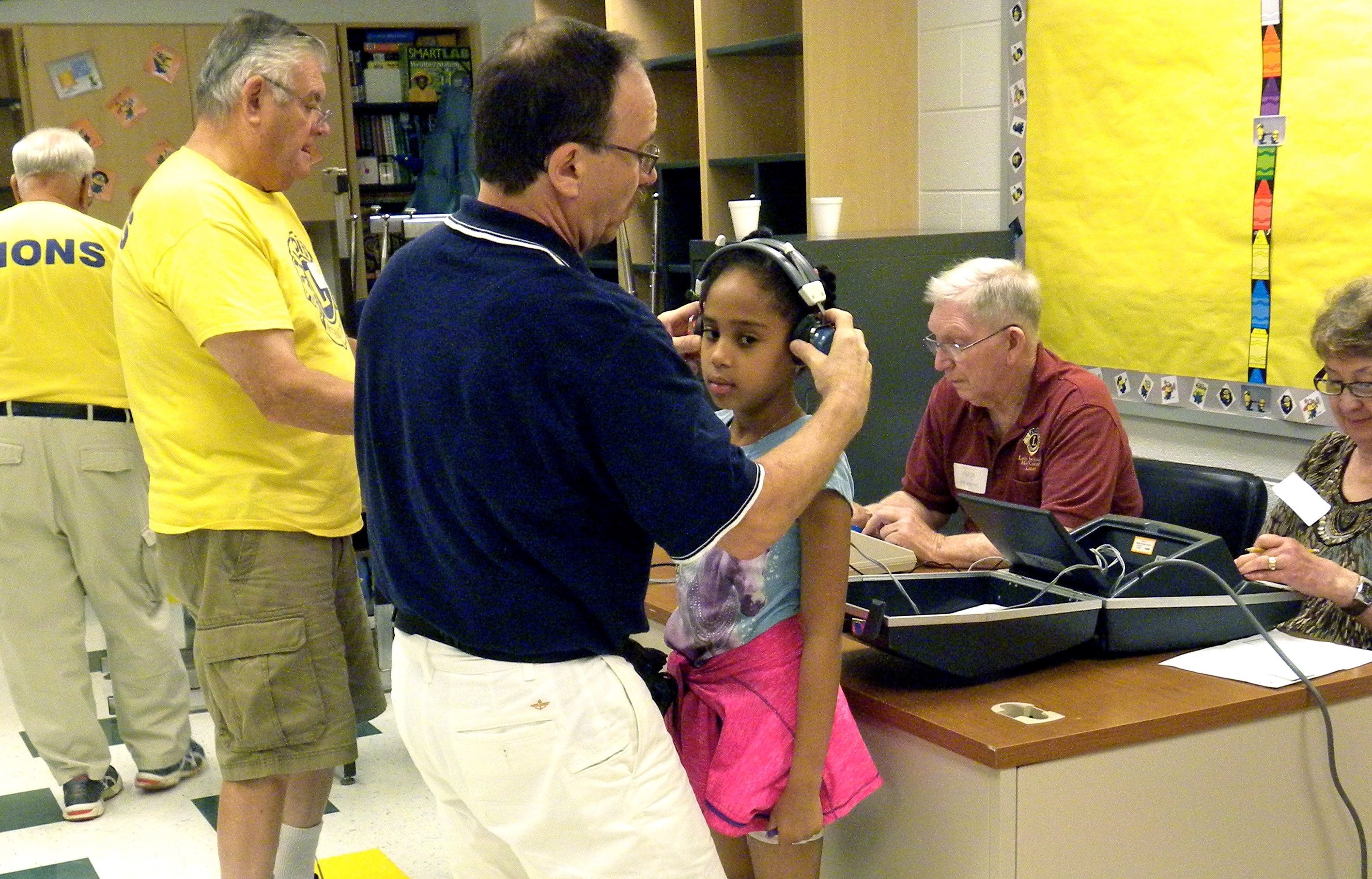
Virginia law requires that schools perform sight and hearing screenings for students in Kindergarten, second or third grade, and seventh and tenth grades, as well as for new students. Area Lions Clubs aid schools in their service areas by performing these screenings free of charge.
For the sight screenings, area clubs use the Welch Allyn (formerly Pediavision) Spot Vision Screener, which resembles a digital camera that can identify problems like near sightedness, far sightedness, astigmatism, amblyopia and eye misalignment. “The eye charts are long gone. Within seconds this machine gives results,” said Lion Joe Angsten, secretary of the Lake Jackson/Mid-County Lions Club.
It Takes an Army
To understand the scale of the Lions’ work, it’s worth noting that from July 1, 2018 to January 31, 2019, the Woodbridge Lions Club alone performed 7,328 vision screenings and 3,291 hearing screenings in 31 Prince William County schools and discovered 1,322 students with vision problems and 275 students with hearing problems that needed follow-up, according to information provided by Lion Dee Pfeiffer, the club’s sight and hearing chairman. During that period, the club performed 1,148 additional vision screenings and 928 additional hearing screenings at 10 other locations.
Across the county, the Manassas Host Lions Club performed 2,022 vision screenings in seven Manassas City schools and discovered 347 students that needed follow-up in 2018, according to Lion John Beere. “We discovered a third grader at Round Elementary whose parents said he had a reading problem,” he said. “Our test prompted the parents to go to a professional, who diagnosed his issue and recommended glasses. His mother said that with the glasses he couldn’t put a book down. We made a difference in his life.”
Although the Lions Clubs screen a range of ages, they focus on children because 80 percent of children with learning disabilities may have an undiagnosed vision issue, and 95 percent of vision issues can be corrected if caught early. “The earlier that we can detect problems with children’s sight, the better chance they have of getting a successful education,” said Lion Gloria Wilson, president of the Park West Lions Club.
All area Lions Clubs also collect and recycle eyeglasses. Since 2007, the Park West Lions Club has been a satellite eyeglass recycling location. According to Wilson, by working with other Lions Clubs and organizations like the Boy Scouts or Girl Scouts, the club has processed more than 120,000 eyeglasses. After processing, the eyeglasses “are sent to our big recycling center in Falls Church to be shipped to mostly third-world countries from there,” she said.
Funding and Recruiting Challenges
All projects require money, and the Lions Clubs raise it themselves through their own fundraising. “Because it’s a non-profit organization, all volunteer, the club has to maintain two separate budgets. One is administrative, that’s where the members’ dues are paid into. The activity budget is the money you gather to spend for community service projects. You can’t mix the money,” Angsten said.
Fundraising efforts vary, as do recruitment drives. Most new members join Lions Clubs because they know existing members. That was the case for Kathy Keys of Manassas who recently joined the Manassas Host Lions Club after getting to know the president and his wife at a local gym. Keys is close to retirement and likes the flexibility Lions Clubs offer.
“The biggest problem with Lions, and I think it’s true of a lot of organizations, is that it’s hard to attract young people. Their schedules are so busy with whatever is going on with the family.
“The average age of our club [members]is maybe late 50s or maybe early 60s,” Angsten said.
For the Park West Lions Club, “the push this year is to recruit more women,” Wilson said.
Lion Helen Eitt, a new member of the Woodbridge Lions Club, was new to the Woodbridge area, and after two meetings with this club, she decided to join.
“I’m looking forward for the opportunity to giving back…I want to give to my community as much as I can…Take my hand and show me what I can do,” she said at her induction.
Learn more about local Lions Clubs at valions.org.
Contributing writer Carla Christiano (cchristiano@princewilliamliving.com) is a native of Prince William County, admitted history geek and a technical writer for Unisys.