

By Rebecca Barnes
Just off Godwin Drive in Manassas stands a modest structure with extraordinary significance. This February, in honor of Black History Month, the Lucasville School will be open on weekends for tours, offering the public an opportunity to experience the only surviving one-room African American schoolhouse in Prince William County.
Located at 10516 Godwin Drive in Manassas, Lucasville School served African American children from 1885 until 1926, during the critical decades following the Civil War. The school educated generations of students from the formerly enslaved and free Black community of Lucasville, a postwar settlement formed so families could build lives, institutions, and a shared future on their own terms.
The school’s founding was rooted in sweeping changes to public education. In 1870, Virginia’s General Assembly established a statewide system of free public schools for all citizens. As the Lucasville neighborhood grew, the Manassas District School Board authorized an elementary school for the community in November 1883. One year later, the board hired H. W. Lloyd to construct the schoolhouse, which was completed by March 1885.
 For African Americans emerging from slavery, education was viewed as both a practical necessity and a pathway to independence. Literacy represented dignity, opportunity, and self-determination. Lucasville School became a place where children could gain the tools needed to shape their own futures in a society that often denied them equal access.
Students at Lucasville School ranged from first through sixth grade, with instruction tailored to each level. Subjects included penmanship, mathematics, geography, reading, and history. Like many “Colored” schools of the era, students also studied Black history during February, often tied to the week of Abraham Lincoln’s birthday.
At least 17 men and women taught at the school during its four decades of operation. Some were fully certified teachers, while others were hired with the requirement that they continue their education. It is likely that some instructors trained at Jenny Dean’s Manassas Industrial School for Colored Youth, which opened in Manassas in 1894 and helped prepare African American students to teach in rural schools throughout the region.
Lucasville School was permanently closed in 1926, in part because Virginia law at the time did not require compulsory school attendance, and rural schools struggled to maintain enrollment. After closing, the building was sold at auction and moved to a farm across present-day Route 234, where it remained for decades. By 2005, the structure had significantly deteriorated. Through a community-led preservation effort, the schoolhouse was dismantled and reconstructed between December 2005 and February 2008, preserving some original boards and restoring the building as a historic site and museum.
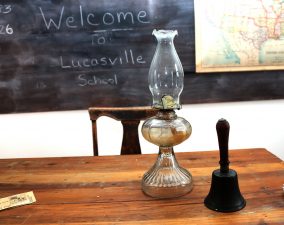
Today, the interior reflects how the school would have appeared during its years of operation. Visitors will find small blackboards, wooden desks and benches, a pot-bellied stove, an oil lamp, and rough-hewn floors. Reproduction furnishings allow guests to physically experience the space, including the cramped seating and simple tools that defined daily life for students more than a century ago.
The Lucasville School stands as a tangible reminder of Prince William County’s African American residents who challenged racism, prioritized education, and laid the groundwork for a lasting public school system. Weekend tours in February provide a meaningful way to honor Black History Month through a deeply local story, one that continues to speak to resilience, determination, and the enduring power of education.
Visitors are encouraged to step inside, sit at the benches, and reflect on the generations of children who passed through this room, learning lessons that reached far beyond its four walls. For more information, visit visitpwc.com/listing/lucasville-school/1944/ Lucasville School, 10516 Godwin Drive, Manassas. 703-365-7895.
Rebecca Barnes is a history major and a lifelong resident of Prince William. As the publisher of Prince William Living, she is passionate about preserving and sharing the stories that shape the community, with a particular focus on local history, cultural heritage, and the people whose lives continue to influence the region today.