
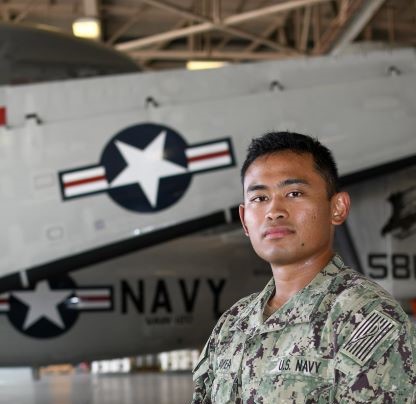
Provided by U.S. Navy Office of Community Outreach
Airman Angelo Eclavea, a native of Manassas, serves the U.S. Navy assigned to Airborne Command and Control Squadron One Two Zero supporting the E-2D carrier airborne early warning aircraft, known as the Hawkeye.
Eclavea joined the Navy one year ago. Today, Eclavea serves as an aviation electrician’s mate.
“I’ve always been drawn to service,” said Eclavea. “Prior to joining the Navy I was a fireman. After doing that for seven years, I wanted to expand my responsibilities and help on a larger scale. I knew the Navy would allow me to do that.”
Growing up in Manassas, Eclavea attended Osbourn Park High School and graduated in 2014.
“I’d like to thank my family and friends back home,” said Eclavea. “They are big supporters of my decision to join the Navy. They’re always there for me whenever I need them. I could not have done this without their support.”
Today, Eclavea relies upon skills and values similar to those found in Manassas to succeed in the military.
“My hometown taught me the value of leadership and management skills,” said Eclavea. “In the Navy, I have been learning how the dynamic of relationships work. Once you understand that, you can help motivate others as well as yourself to accomplish any mission
These lessons have helped Eclavea while serving with Airborne Command and Control Squadron One Two Zero.
The E-2D Advanced Hawkeye recently celebrated the 15th anniversary of its first flight, which occurred Aug. 3, 2007. Known as the Navy’s “digital quarterback,” the Hawkeye gives the warfighter expanded battlespace awareness. The Hawkeye’s command and control capability makes it a multi-mission platform through its ability to coordinate concurrent missions such as airborne strike, land force support, rescue operations and support for drug interdiction operations. The Hawkeye is one of the aircraft launched from an aircraft carrier.
Navy aircraft carriers are designed for a 50-year service life. When the air wing is embarked, the ship carries more than 70 attack fighter jets, helicopters and other aircraft, all of which take off from and land aboard the carrier at sea. With more than 5,000 sailors serving aboard, the aircraft carrier is a self-contained mobile airport.
Aircraft carriers are often the first response to a global crisis because of their ability to operate freely in international waters anywhere on the world’s oceans.
Since USS Langley’s commissioning 100 years ago, the nation’s aircraft carriers and embarked carrier air wings have projected power, sustained sea control, bolstered deterrence, provided humanitarian assistance and disaster relief, and maintained enduring commitments worldwide.
“The aircraft carrier is our U.S. Navy’s centerpiece, our flagship, and a constant reminder to the rest of the world of our enduring maritime presence and influence,” said Rear Adm. James P. Downey, USN, Program Executive Officer (PEO) Aircraft Carriers. “These ships touch every part of our Navy’s mission to project power, ensure sea control, and deter our adversaries.”
Serving in the Navy means Eclavea is part of a team that is taking on new importance in America’s focus on strengthening alliances, modernizing capabilities, increasing capacities and maintaining military readiness in support of the National Defense Strategy.
“The Navy contributes to the National Defense Strategy through preservation of maritime freedom,” said Eclavea. “The Navy does a very good job of making our presence known in areas where freedom may be contested.”
With more than 90 percent of all trade traveling by sea, and 95 percent of the world’s international phone and internet traffic carried through fiber optic cables lying on the ocean floor, Navy officials continue to emphasize the importance of accelerating America’s advantage at sea.
“Maintaining the world’s best Navy is an investment in the security and prosperity of the United States, as well as the stability of our world,” said Adm. Mike Gilday, Chief of Naval Operations. “The U.S. Navy—forward deployed and integrated with all elements of national power—deters conflict, strengthens our alliances and partnerships, and guarantees free and open access to the world’s oceans. As the United States responds to the security environment through integrated deterrence, our Navy must continue to deploy forward and campaign with a ready, capable, combat-credible fleet.”
Eclavea and the sailors they serve with have many opportunities to achieve accomplishments during their military service.
“My proudest Navy accomplishment is creating meaningful relationships with my superiors and my shipmates,” said Eclavea. “It’s made an impact on my life more than I ever thought it would.”
As Eclavea and other sailors continue to train and perform missions, they take pride in serving their country in the United States Navy.
“To me, serving in the Navy means completing the Navy’s mission,” added Eclavea. “Whatever the Navy and my country asks of me, I am there to answer the call.”