
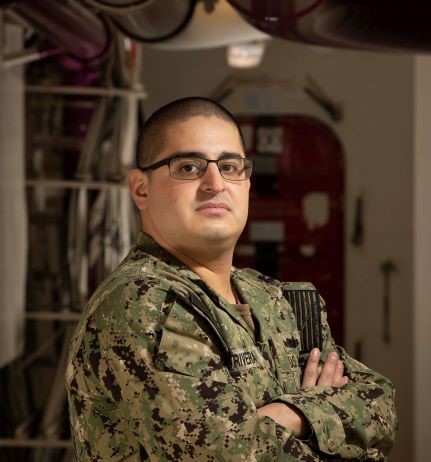
Provided by Navy Office of Community Outreach
Petty Officer 1st Class Christopher Rivera, a native of Woodbridge, serves the U.S. Navy aboard one of the world’s largest warships, the U.S. Navy aircraft carrier USS Gerald R. Ford.
Rivera joined the Navy 14 years ago. Today, Rivera serves as an electrician’s mate.
“Things were not going as planned in my life and I needed a second chance for myself and my future,” said Rivera. “I joined the Navy to get back on track.”
Growing up in Woodbridge, Rivera graduated from Forest Park High School in 2007. Today, Rivera relies upon skills and values similar to those found in Woodbridge to succeed in the military.
“Growing up I learned how to be respectful and think on my feet,” said Rivera. “We used backyard sports to learn how to think on our feet and my grandparents, cousins and friends taught me to respect others.
These lessons have helped Rivera while serving in the Navy.
Aircraft carriers provide unique capabilities and survivability. They are a powerful exhibition of the American Navy’s legacy of innovation, technological evolution, and maritime dominance, according to Navy officials.
USS Gerald R. Ford (CVN 78) represents the first major design investment in aircraft carriers since the 1960s. The ship is engineered to support new technologies and a modern air wing essential to deterring and defeating near-peer adversaries in a complex maritime environment. Ford delivers a significant increase in sortie generation rate, approximately three times more electrical generation capacity, and a $4 billion reduction in total life-cycle cost per ship, when compared to a Nimitz-class aircraft carrier. Once deployed, the Ford-class will serve as the centerpiece of strike group operations through the 21st century, supporting a host of evolving national strategic objectives. When the air wing is embarked, the ship carries more than 70 attack fighter jets, helicopters and other aircraft, all of which take off from and land from FORD’s state-of-the-art Electromagnetic Aircraft Launch System (EMALS) and Advanced Arresting Gear (AAG). With nearly 5,000 Sailors serving aboard, Ford is a self-contained mobile airport.
Aircraft carriers are often the first response to a global crisis because of their ability to operate freely in international waters anywhere on the world’s oceans. Carrier strike groups have the unique advantage of mobility, making them far more strategically advantageous than fixed-site bases. No other weapon system can deploy and operate forward with a full-sized, nuclear-powered aircraft carrier’s speed, endurance, agility, and the combat capability of its air wing.
“I could not be more proud of our sailors; this crew displayed a phenomenal amount of resiliency and proficiency during each phase of our operational development,” said Capt. Paul Lanzilotta, Ford’s commanding officer. “The crew’s efforts are what make Warship 78 so great, and I can’t wait to be a part of what this mighty warship and her crew achieve in 2022.”
Since USS Langley’s commissioning 100 years ago, the nation’s aircraft carriers, such as Ford, and embarked carrier air wings have projected power, sustained sea control, bolstered deterrence, provided humanitarian assistance and disaster relief, and maintained enduring commitments worldwide. Gerald R. Ford represents a generational leap in the aircraft carrier’s capacity to project power on a global scale.
“The aircraft carrier is our U.S. Navy’s centerpiece, our flagship, and a constant reminder to the rest of the world of our enduring maritime presence and influence,” said Rear Arm. James P. Downey, USN, Program Executive Officer (PEO) Aircraft Carriers. “These ships touch every part of our Navy’s mission to project power, ensure sea control, and deter our adversaries.”
Serving in the Navy means Rivera is part of a team that is taking on new importance in America’s focus on rebuilding military readiness, strengthening alliances and reforming business practices in support of the National Defense Strategy.
“The Navy displays our presence in the seas, provides aid and helps other countries with various missions.” said Rivera.
With more than 90 percent of all trade traveling by sea, and 95 percent of the world’s international phone and internet traffic carried through fiber optic cables lying on the ocean floor, Navy officials continue to emphasize that the prosperity and security of the United States is directly linked to a strong and ready Navy.
Rivera and the sailors they serve with have many opportunities to achieve accomplishments during their military service.
“I’m proud of receiving my small craft pin which allows me to become mission commander for small boys during escort missions,” said Rivera. “Mission commanders direct the flow of the ship’s escort and make sure that no hostiles come through during the escort process.”
As Rivera and other sailors continue to train and perform missions, they take pride in serving their country in the United States Navy.
“Serving in the Navy, for me, is the chance to see what type of person you are out of your hometown,” added Rivera. “Who you are while you’re with people from different places with different backgrounds and ways of thinking.”